Midseason Scouting Notes (Part I)

At the end of November, I released my ‘Early Season Scouting Notes’, which touched on 20 different prospects including: top prospects, under-the-radar prospects, potential returners to keep an eye on, and more. Now that we’re close to being halfway through the college season and conference play has kicked off, I thought it’d be a good time to do something similar.
In this piece, I’ll go over 8 different players similar to the previous edition of this piece, although I’ll go a little more in-depth on some of the players. As always, this will include strengths, weaknesses, a specific part of their game that stands out, some questions surrounding their game, etc. The order of prospects below isn’t a reflection of my own rankings, but I will start with prospects who are ranked higher according to consensus and work my way down from there. With that said, let’s get right into it.
*Writing pieces like this can be tough because of how many games happen each day and that results in having to constantly change the numbers in this piece. To keep things simple and consistent, all of the numbers in this piece are through Jan 8th. Games played on January 9th or later are not included.
Ja’Kobe Walter (Baylor) has continued to shoot at a very high level since I included him in the last edition of this. Through 14 games, Walter is shooting 40% (32-80) from 3 - you can see an additional breakdown I put together below:
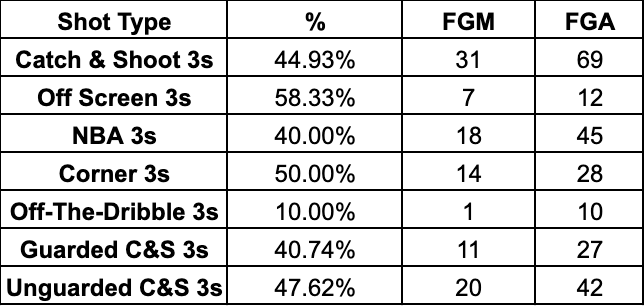
As you can see, he’s been an awesome shooter in most situations outside of off-the-dribble 3s. His ability to shoot off-movement and get his feet set quickly are two traits that make him such an impressive shooter, and he’s even had a few shots where he sped up his release, which makes it difficult for defenders who are closing out on him to affect his shot.
Moving to the other side of the ball though, the defense has been underwhelming at times. Against Duke, he got attacked by their guards (Roach, McCain, and Foster) a good amount that led to a bunch of looks at the rim as seen in the video below.
With Walter being discussed as a potential top 5 pick, he’s going to have to show more consistency on the defensive end or prove that he can do a little more with the ball in his hands and create shots for himself. Right now, he’s still a very good prospect, but most of his value comes strictly from him being a really good shooter. To put things into perspective, I think Moses Moody as a prospect at Arkansas was a little bit of a better prospect than what Walter has shown so far.
Rob Dillingham (Kentucky) might be a smaller guard, but he’s a very good prospect regardless. His combination of handles, shotmaking, and passing make him an intriguing guard who can play with the ball in his hands, but an underrated aspect of his game is how smart of an off-ball player he is. Kentucky guards have a history of being very good off-ball players (Booker, Murray, Maxey, Herro, Quickley, etc.) even if they are capable on-ball players as well, and Dillingham fits that mold. His relocations and understanding of spacing on offense are very good. He’ll set up defenders by walking them down before coming off of a screen, will change speeds to create separation, and will read how his defender is defending him (trailing, etc).
The main thing for Dillingham to improve upon right now is his ability to get easier shots at the rim in the halfcourt, which is something I touched on in my piece ‘Bad Games With Important Takeaways: Rob Dillingham’ a month ago when I went over his struggles against UNC Wilmington. He’s able to use his handle to get some looks at the rim, but he still struggles to get easier looks at a higher volume. If this is something that improves just a little, or something you are optimistic about going forward, he deserves top 5 consideration in this class.
Reed Sheppard (Kentucky) is another smaller guard on Kentucky, but he has also been one of the best freshmen in the country. From an impact standpoint, he has been the most impactful freshman in the country, but that doesn’t necessarily mean he’s the best freshman prospect because there are still questions about how his game might translate. Before getting into that, just look at the company that Reed Sheppard is in when comparing him to other freshmen who have had a BPM ≥ 12.
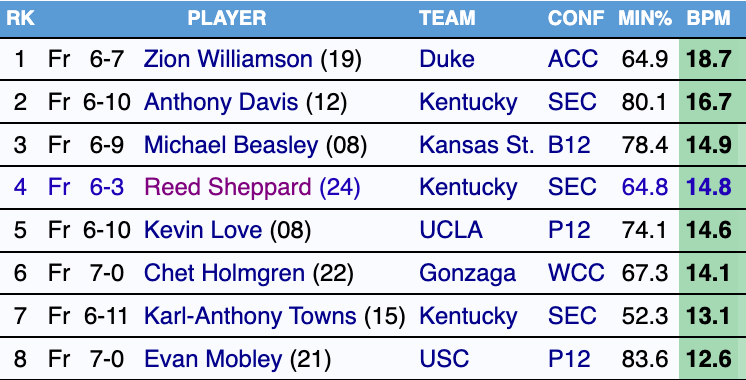
This is some elite company and it will be interesting to see if Sheppard is able to keep up this level of play. He’s currently shooting 54.7% (29-53) from 3, so there should be some shooting regression coming.
One of the questions surrounding Sheppard is whether or not he’s capable of being a point guard or if he’s more of a 3-D guard. I tend to lean more on the 3-D guard side because I don’t think he creates good looks consistently enough for himself or the team, and I think some of his decision-making, when asked to do that this year, has been questionable. That being said, it’s worth noting that it has gotten better each game (his passing looked good in the recent Miami game). That then brings up the question of how valuable a smaller 3-D guard is in the NBA.
The list of elite shooters being great defenders at his size is small. Kentavious Caldwell-Pope is one of the best 3-D guards in the league, but he has a couple of inches on Sheppard. I’m personally not a huge fan of comparisons, but one of the names that stuck the most when thinking about this list was George Hill. To be clear, I think Hill was more skilled on-ball and had a significantly longer wingspan, so it isn’t a direct comparison whatsoever. Just trying to think of some players who had similar body types and close enough play styles. I also don’t think Sheppard is at the same level of defense as guys like KCP, Caruso, Melton, etc. are, so these are some things worth considering. But then again, you look at that list above and watch how impactful he is on film, and it’s hard to say he won’t be able to find a role at the next level.
Yves Missi (Baylor) has been a surprise breakout freshman who has worked his way into one-and-done conversations. The 7’0” big is one of the best rebounders in the country (especially on the offensive end), a really good screener, and a good finisher with his ability to be a vertical threat catching lobs on the roll. Additionally, he looks to seal off his man on the roll which helps open up easier lanes to the basket for his guards or gives him good positioning for an offensive rebound.
As of now, there has only been one freshman since 2008 to meet the following filters:
Offensive Rebound % ≥ 17
Defensive Rebound % ≥ 17
Dunks ≥ 30
That player was DeMarcus Cousins. Yves Missi is currently at 19.3 OREB%, 17.9 DREB, and 27 dunks. If the rebounding holds the rest of the season, Missi will join Cousins after 3 more dunks, although Cousins had a total of 53 dunks on the season, a number Missi is on pace to pass.
On the defensive end, Missi has potential with his mobility and shot blocking ability. For a majority of the game against Duke, Missi did an awesome job on Filipowski, even if Filipowski might have gotten the better of him on a couple of possessions (I would highly recommend watching that game). The reason I brought up Missi’s defense as ‘potential’ is because he isn’t a consistently impactful defender yet. While his mobility and athletic tools are intriguing, his footwork is poor at times, which allows him to get beat; additionally, there’s room for improvement with his feel and ability to read the floor.
Overall, Missi has a combination of a solid – but replaceable – offensive skillset that can compliment dynamic guards while having potential on the defensive end. As of right now, Missi is worth a pick in the 20-40 range, but depending on how Missi’s defense looks / improves throughout the rest of the year, he could be worth a pick anywhere between 10-40 come draft time.
Oso Ighodaro (Marquette) is one of the better passing big men in this class, if not the best. His quick processing and ability to make passes on the short roll allows Marquette to capitalize on advantageous situations out of ball screens.
In addition to his passing, his touch is also very good. This year, he’s been very effective at the rim, shooting 66.2% (44-71) on such attempts. If we exclude dunks and look at his ‘touch shots’ (something I’ve talked about in the past that I define as layups + runners + hooks), he’s shooting 58.6% (51-87) on all touch shots and 64.3% on floaters (18-28), both extremely valuable tools on the roll.
Unlike Missi’s offensive skillset, Ighodaro’s short-roll playmaking is tough to find. That being said, Ighodaro’s ability to make plays on the short roll and ability to initiate some offensive possessions is not something that every team will give him the freedom to do, so landing with a team that understands what he can do and give him a chance to maximize his skillset will be important.
While Ighodaro has a unique offensive skillset compared to someone like Missi, his physical tools and his rebounding are lacking, especially compared to Missi. That being said, Ighodaro is incredibly smart on both ends of the floor, and that helps him a lot on the defensive end.
Reece Beekman (Virginia) has shown a lot of growth as a point guard and as a playmaker throughout his college career. Here is a chart showing his assist numbers each season:
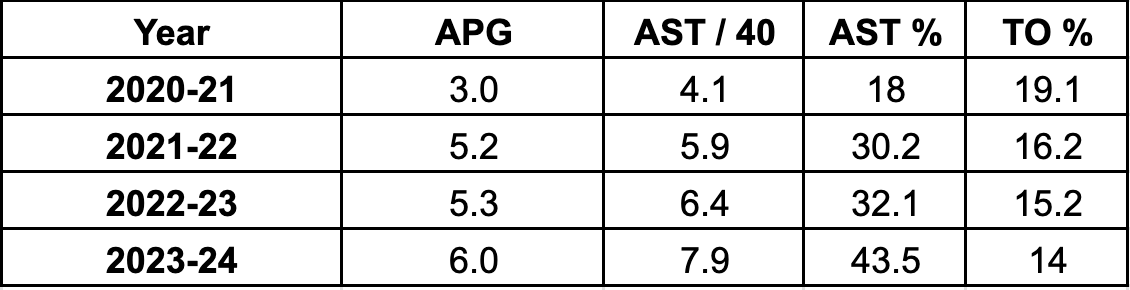
Being one of the best and most disruptive guard defenders in the country, Beekman was originally viewed as a 3-D guard, and though that still might be his most likely path to success, his improvement and growth as a passer has at least given him another potential path to success.
Beekman doesn’t have great quickness when trying to beat guys off the dribble, and that will only get tougher at the NBA level. That being said, he’s able to find ways to win and beat his man by using his handles, craftiness, and ability to change pace / directions.
Whether you view Beekman primarily as a 3-D guard or point guard will probably depend on how you feel about his shot, which has taken a big dip this year. After being a somewhat respectable shooter the previous two years (35.1 3PT%, 27-77 last year), he is shooting just 27.5% (11-40) through 15 games. There’s a small hitch in his shot and his release / follow through isn’t consistent, which is somewhat worrisome, but his previous shooting numbers and the fact that he has shot between 75-80% from the FT line in each of his college seasons leave some room for optimism as well.
Devin Carter (Providence) has shown significant improvements as a shooter. He’s already made more 3s through 14 games this year than he did in 33 games last year.
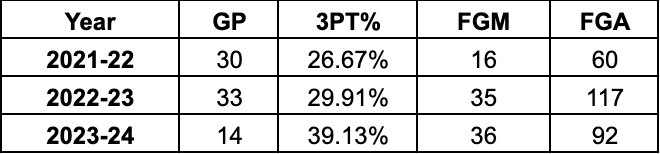
While this is still a small sample size when we have two full seasons of data with him struggling, the volume (almost shooting twice as many 3s per game as last year) and shot difficulty (deep range, off-movement 3s, etc.) are two things that have me buying the improvements at least to a certain extent. Carter might not be a 39% 3PT shooter on high volume, but he’s definitely a better shooter than the 29.9% that he shot last year.
Aside from the shot, Carter is a very smart player on both ends of the floor, and similar to Beekman, a really good on-ball defender as well. Both Beekman and Carter are awesome defenders, but unfortunately have the disadvantage of being on the smaller side, so they don’t have the luxury of bringing versatility and being capable of defending wings.
Where Carter struggles a bit on the offensive end is when he’s forced to put the ball on the floor. His handle isn’t great which allows defenses to strip the ball pretty often, and he struggles finishing at the rim in traffic in the halfcourt.
Kyshawn George (Miami) is someone that I’m keeping a close eye on as a potential 2025 breakout returner. Though it isn’t impossible for him to end up being one-and-done, it seems unlikely at the moment. At 6’8”, George has really popped as a shooter, shooting 43.1% (35-58) from 3 through 14 games, and 47.8% (22-46) on catch and shoot 3s.
In addition to his shooting, he’s flashed some impressive passes and defensive playmaking, but there are some concerns about his ability to score from inside the arc as he is currently shooting 42.9% (6-14) at the rim and 33.3% (7-21) on all 2s. These areas of his game will be important to keep an eye on throughout the rest of the year. If he’s able to show good progress, there’s a chance he ends up getting enough draft interest to leave, but if not, it will be something he works on in the offseason and as he heads into the next season as one of the more intriguing returners.
Kwame Evans Jr (Oregon) has been incredible over the last month and a lot of that success has come from his ability to play the 5 for Oregon while they have dealt with injuries to N’Faly Dante and Nate Bittle. Since December 9th, Evans is one of four freshmen with a BPM ≥ 10 and a large part has been because of his defense. Over this stretch, he has a 7.9 BLK% and a 5.2 STL% and for the full season he has a 6.5 BLK% and 4.3 STL%. However you want to slice it, his defense has been extremely impressive.
Whether or not you believe he is capable of playing the 5 in the NBA will play a big part in how he’s evaluated as a prospect, but it will be very interesting to see how he looks if / when Oregon’s bigs get healthy again.
For inquiries about obtaining a full scouting report on any prospect, please contact me at: ZachMilner13@gmail.com
Twitter: ZachMilner13